
Why CAMA? Three Reasons. One Solution
CAMA was created to solve three distinct problems that no other framework addresses: AI performance, enterprise completeness, and deterministic models. Here is why each matters—and how CAMA solves them.
AI Is Only as Good as the Context It Receives.
Without structured, scoped context, AI is a generalist that gives generic answers. It hallucinates. It misses nuance. It cannot be trusted for enterprise decisions.
The core problem is simple: business understanding. AI agents need the right amount of structured business context to answer questions with precision. Too little context, and they guess. Too much context, and they become confused or overwhelmed.
The Core Insight: Business Understanding.
“Business understanding” is the ability to provide AI with the right information about who is asking and what their business is—so it can give relevant, accurate answers.
CAMA solves this by providing a library of canonical models—stable, versioned, tag-addressable blueprints that give AI the business understanding it needs to operate with accuracy and determinism.
CAMA provides the business understanding AI needs to give relevant, accurate answers.
The Lemonade Stand Problem: Business Understanding Matters.
Imagine two different people ask an AI the same question:
“What should I do to increase sales next quarter?”
Scenario 1: A Kid Running a Lemonade Stand
The AI gives a generic response:
- “Advertise more.”
- “Work harder.”
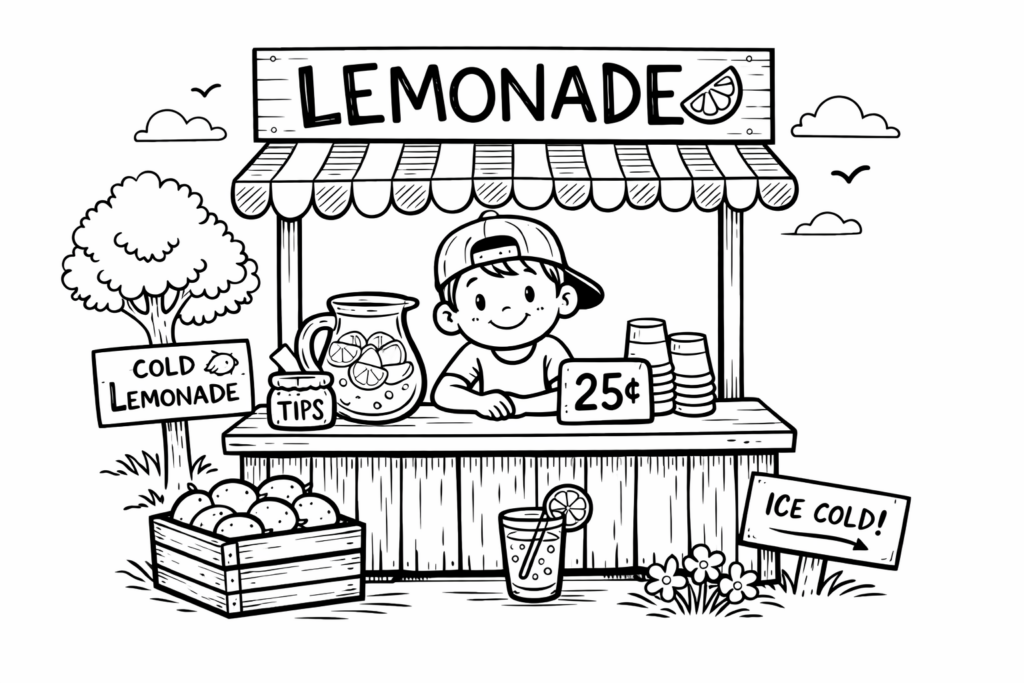
For a kid looking for extra cash over the summer, this advice is fine.
Scenario 2: A CEO of a Fortune-500 Corporation
The AI gives a same response:
- “Advertise more.”
- “Work harder.”
This answer is completely wrong. It’s useless. It’s insulting.
The Problem:
The AI gave the same answer to both questions because it lacked business understanding. It didn’t know who was asking. It didn’t understand the business.
The Solution:
CAMA provides the business understanding AI needs:
- Who is asking? (A CEO)
- What is the business? (A Fortune-500 corporation)
- What are the strategic objectives? (Market share, profitability, shareholder value)
- What are the constraints? (Regulatory, financial, operational)
- What has been tried before? (Historical performance, past strategies)
With business understanding, the AI can give a specific, actionable, enterprise-grade answer.
The difference is scoping. The AI went from generic to specific because it understood the context. to specific because it had structured, relevant context.
The same question gets different answers based on business understanding. AI needs to understand the business to give relevant answers.
A side-by-side comparison:
| Aspect | Kid’s Lemonade Stand | Fortune-500 CEO |
|---|---|---|
| Question | “What should I do to increase sales next quarter?” | “What should I do to increase sales next quarter?” |
| AI Response | “Advertise more. Work harder.” | “Advertise more. Work harder.” |
| Is It Useful? | ✅ Fine. Vague but not wrong. | ❌ Completely wrong. Insulting. Useless. |
| Why? | AI didn’t know who was asking. | AI didn’t know who was asking. |
Why Existing Frameworks Fail.
Previous frameworks share a common failure mode: they are descriptive, not executable.
Frameworks like TOGAF and BizBOK are used by humans to talk about the business, not to run it. They produce beautiful documents that are out of date the moment they are approved. They are interpretive, not deterministic.
The Result:
Enterprises spend billions on frameworks that produce beautiful documents that are out of date the moment they are approved.
The Gap:
No existing framework provides a complete, executable blueprint of the enterprise that AI can consume directly.
The Need for Deterministic Models, Consistent Models.
AI cannot operate on ambiguity. It needs reliable, versioned, traceable context. Existing frameworks fail this test in three ways:
1. Inconsistent Interpretation
Different practitioners interpret the same framework differently for the same process. No two implementations are alike. One architect’s “business capability” is another architect’s “value stream.” This inconsistency makes frameworks useless to AI.
2. Irrelevant Concepts
Frameworks use fancy words and concepts that AI doesn’t care about and executives don’t understand. They add complexity without value. They are designed to sound sophisticated, not to be useful.
3. Non-Deterministic Models
AI cannot operate on interpretive, ambiguous models. It needs deterministic, versioned, traceable models that it can trust.
The CAMA Solution:
CAMA models are:
- Deterministic — defined once, versioned, and consumed consistently by AI
- Lean and Purposeful — every model serves a clear function in the AI context
- Tag-Addressable — AI finds what it needs instantly
- Versioned — models evolve without breaking existing implementations
- Provenance-Ready — every model is traceable to its source
Frameworks that are open to interpretation are useless to AI. CAMA models are deterministic, consistent, and purposeful.
The Three Reasons, One Solution.
CAMA is the first framework to solve all three problems:
| Problem | CAMA Solution |
|---|---|
| AI Performance | Canonical models provide business understanding. |
| Enterprise Completeness | 59 canonical models cover the entire enterprise. |
| Deterministic Models, Consistent Models | Tag-addressable, versioned, lean, and purposeful—designed for AI. |
AI Recommends. Humans Decide.
What Belongs in the Standard?
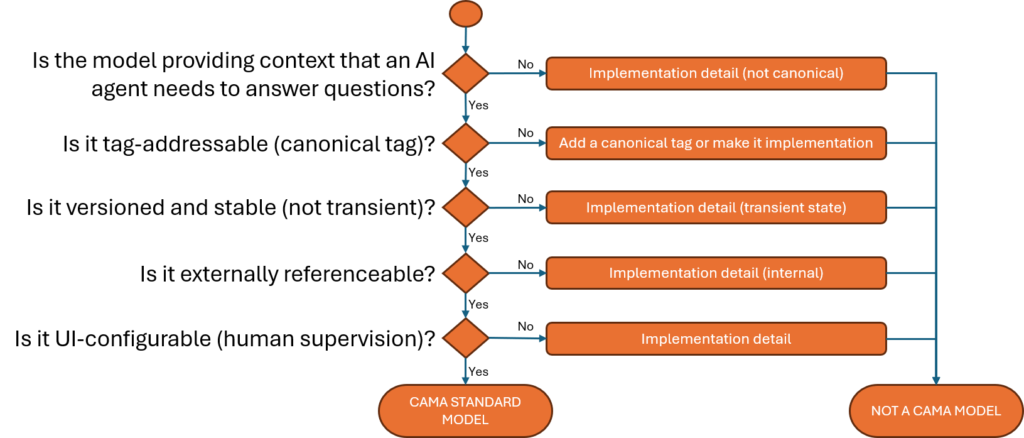
A model belongs in the CAMA standard if it is a structured, tag-addressable, versioned representation of a business concept that an AI agent needs to know to provide accurate, scoped answers.
The Eight Criteria:
| Criterion | Description |
|---|---|
| 1. AI Context Provider | Does this model provide context that an AI agent needs to answer questions accurately? |
| 2. Tag-Addressable | Does it have a unique canonical tag for deterministic discovery? |
| 3. Versioned | Can it evolve without breaking existing implementations? |
| 4. Stable | Does it represent a long-lived business concept (not transient state)? |
| 5. Externally Referenceable | Do other models need to reference it by tag? |
| 6. UI-Configurable | Do humans need to configure, validate, or supervise it via UI? |
| 7. Searchable | Does it have search terms for semantic discovery? |
| 8. Provenance-Ready | Can it be traced back to its source (evidence, regulation, policy)? |
A model belongs in the CAMA standard if it provides structured, tag-addressable, versioned context that AI needs to answer questions accurately.
How We Decide What Belongs in the Standard.
The decision framework ensures that only models meeting all eight criteria are included in the CAMA standard.
The First Framework for AI, Not Just About AI.
CAMA is not another framework for humans to read and interpret. It is the first framework designed by AI for AI to execute—with humans as decision-makers, not executors. Everything else has been a preparation for this.
CAMA is the first framework designed by AI for AI to execute—with humans as decision-makers, not executor
Ready to Explore the CAMA Standard?
Dive into the complete canonical model inventory, documentation, and implementation guides.
The Vision Behind CAMA.
CAMA was created to solve the fundamental AI accuracy problem: how to provide AI with the right, structured context at the right time. Without business understanding, AI is a generalist that gives generic answers. With business understanding, AI becomes a specialist that knows your business, your goals, your risks, and your operations—enabling accurate, high-performance, autonomous orchestration.